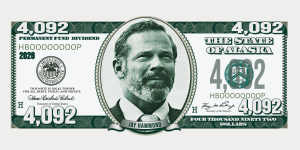
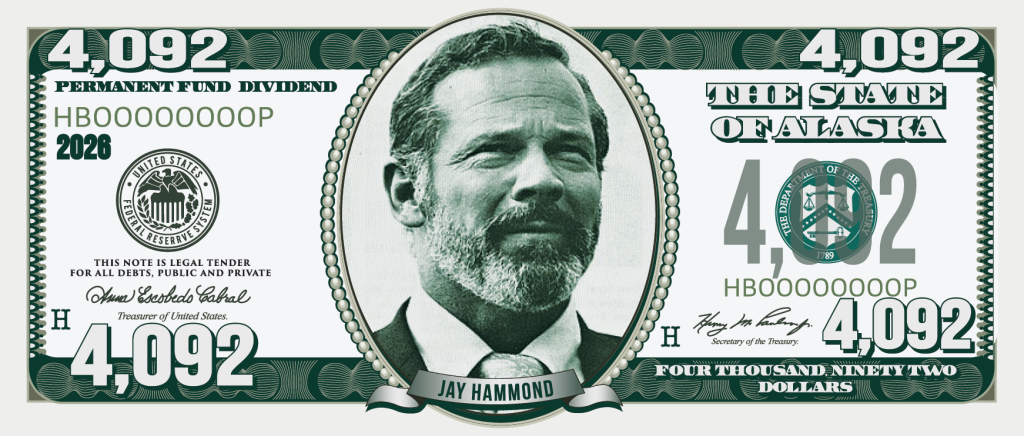

(The amount of the PFD this year was $4.092 before legislators in Juneau spent more than 70% of it)
Legislators sometimes misplace their integrity. It is especially damaging when those same legislators also wear their Christian faith prominently at election time.
Rep. Sarah Vance (State Chair of the National Association of Christian Lawmakers), Rep. Kevin McCabe (State Vice Chair of the National Association of Christian Lawmakers) and Rep. Jubilee Underwood (R-Wasilla) went out of their way to gaslight Alaskans last week by declaring “This Anti-PFD Vote Never Happened.” I recommend reading it.
The article is a powerful example of how Juneau’s political establishment responds to conservatives, not by confronting conservative arguments, but by seeking to drown them out using voices and faces already familiar to conservative voters.
Alaskans are receiving $1,200 of this year’s $4,092 dividend as checks go out this week. That is what is left after legislators diverted a whopping 71% of the PFD to other legislative priorities—like spending $12 million to subsidize seafood and tourism.
To his credit, Governor Dunleavy did veto some of the subsidies, and he did include a full PFD in his budget, but the governor cannot restore money to the dividend after legislators have already voted to cut it.
The legislators who advocated diverting money from this year’s dividend owe Alaskans an apology. The legislators who voted to go along with it also owe an apology. Both voted to break the law instead of voting to change it. Every year that legislators vote to break the law is another year they deny the constitutional right of voters to hold a referendum on the PFD.
While it is important to hold legislators accountable for breaking the law again this year, it is also important to understand some of the reasons why they did it. When Rep. Jubilee Underwood states that she supports “protecting a meaningful and sustainable PFD…” (legislative parlance for a reduced PFD) she is simply echoing the position of most legislators in Juneau.
In the legislature, it is now taken for granted that every House legislator will vote to cut the dividend. The PFD represents billions that can be redirected to special interests. One Democrat legislator said the quiet part out loud. If legislators ever lost the ability to redirect the PFD to special interests they would lose power and “Our role as legislators would seriously regress (watch video).”
Therefore, to insist that legislators follow the law and distribute a full dividend is to betray the interests of your fellow legislators and risk becoming a pariah in Juneau. It also means betraying the interests of the very groups in Juneau that many legislators rely on for campaign donations at election time. For most legislators, that is a non-starter.
The Alaska Permanent Fund is now roughly $40 billion larger than it was when Governor Walker first vetoed the PFD in 2016. For legislators, the PFD is not a math problem. It is a political problem.
Legislators could have voted to follow the law and distribute a full PFD this year, but the thought of doing so absolutely terrifies both the special interests and the many legislators beholden to them. If voters receive a full dividend, even once, they might expect it to happen again the following year. That would directly conflict with the other plans that Juneau already has for that money.
Legislators recognize that they cannot vote to reduce the PFD in statute without having to defend their vote in a public referendum. They also recognize that they cannot vote to distribute a full PFD without significantly undermining their own power and influence as legislators.
In the halls of the capitol building, the public sector must be prioritized and the private sector must be made to bear the costs. Legislators willing to keep the money flowing in Juneau are rewarded. Legislators who object too strongly are punished. That is the political reality that legislators face in Juneau today, and it directly conflicts with the expectations of folks back home.
Upon returning home, legislators could simply apologize. The pressure was too much. The current was too strong. That would be one option. Or, you could find two other legislators in the same boat and declare in unison “This Anti-PFD Vote Never Happened.”
In their article, Underwood, Vance and McCabe first assert that the vote to cut the PFD never happened, and then later that the vote didn’t really matter. Further on, they say that it would have been a waste of time to oppose it. They also say that, after the vote to pull the full PFD out of the budget, they voted to try to put the full PFD back into the budget (but failed to get enough votes), and the second vote is the only one that should count.
Finally, they conclude by arguing that, since the chances of getting 21 votes for a full PFD are “almost nil”, we should abandon that fight and instead focus our attention on fighting to get 41 legislators (nearly twice as many) to vote to pass a constitutional amendment, because that would be more realistic. Don’t take my word for it, please read this mind-numbing logic in their own words.
Here are The Receipts
On December 11, Dunleavy included a “Full statutory Permanent Fund Dividend” in the budget he sent to the legislature (also referred to as House Bill 263).
The question these legislators should answer is this: If the governor included a full PFD in the budget, when was the full PFD taken out of the budget, and who voted for it?
It’s no more complicated than that.
It’s a fair question, and one that Vance, McCabe and Underwood know the answer to.
On February 11, the House Finance Committee initially recommended diverting 100% of the PFD to state spending. On April 1, they revised their recommendation to include diverting only 60% of the dividend.
On April 8, Rep. Chuck Kopp stood up and asked every member of the Alaska House of Representatives to consent to adopting those recommendations and replacing the governor’s budget with the budget proposed by the Democrat-led House Finance Committee. Every legislator (including Vance, McCabe and Underwood) consented, and the governor’s budget with a full PFD was thrown out and replaced with the budget recommended by the finance committee, cutting 60% of the dividend.
In the Legislature, the entire body is required to make that decision together. If even one of the 40 members of the House had stood up to object, unanimous consent would have failed. Those seeking to throw out the governor’s budget would then have had to call for a roll call vote and found at least 21 legislators willing to put themselves on record by voting to do so. No one objected, so Dunleavy’s budget was tossed without legislators needing to individually vote for it. The roll call that day showed all 40 legislators present and 40 legislators were given credit for voting in favor of adopting the new budget.
In their article, Vance, McCabe and Underwood claim that their vote to replace the governor’s budget wasn’t a vote. It was only a “procedural motion,” they say. Objecting would have wasted days of time, they say. Your dividend went from $4,092 in the governor’s bill to $1,200. That’s a 71% cut. That counts.
Instead of apologizing, they equivocate.
What’s worse is that they know better. Underwood has been a legislator for two years, McCabe for six, and Vance for eight years.
McCabe has even stood with me in the past to object on this very same vote (watch video).
Before they lost their way, Vance and McCabe voted with us repeatedly to defend the governor’s budget with the full PFD and reject the Democrats’ replacement budget. They were on camera when they voted the right way (see video). They are now on camera voting the wrong way (see video).
You can watch video after video of Republican legislators (including Vance and McCabe) voting with us, year after year, to fight for the governor’s budget and the dividend. In 2019, the vote was 24-13 with 13 Republicans voting to keep the governor’s budget. By 2021, that number had risen to 16, with a vote of 23-16. In 2022, the vote was 22-14. In 2023, that number dropped to 39-1. I was the only legislator to stand up and object in 2023, and again in 2024. This year, I was no longer in the legislature, and the vote became 40-0 for the first time in many years.
In years past, most Republicans could be expected to stand together and passionately defend the governor’s budget and the full PFD from attempts by Democrats to replace it with their own budget (see video). Yet, when Democrats sought to replace the governor’s budget this year, they encountered only silence from Republicans.
In years past, most Republicans could be counted on to come together and oppose items like the seafood and tourism subsidies that Dunleavy vetoed this year (Vance being one of the few exceptions who sided with Democrats). By 2024, both McCabe and Vance joined Democrats in voting for the subsidies, but most Republicans still remained opposed. This year, House Republicans didn’t even try to oppose the subsidies. The governor had to step out on his own to trim them.
In their article, Vance, McCabe and Underwood claim that, after the vote to pull the full PFD out of the budget, they later voted to try to put it back in, and that the second vote is the one that should count. Here is why that claim doesn’t hold water.
In the House, it requires 21 votes (or a majority of legislators present) to override the governor and remove an item from his proposed budget. If you are going to fight for a full PFD that is where you make your stand.
In contrast, it only requires 20 votes to support the governor and keep the full PFD in the budget. If you can’t find 20 votes and Democrats succeed in cutting the full PFD out of the budget, it is exponentially more difficult to then try to find 21 votes to put it back in.
Voting to remove the full PFD, and then voting to put it back in (which requires a higher vote threshold and is certain to fail), is nothing more than a sleight of hand. Sadly, these are the gymnastics that legislators go through every year to cut the dividend, spend most of it, and then point fingers at each other at election time. Whether you happen to support a full PFD or not, the people of Alaska deserve far better than this.
There are many things that desperately need to be fought for in Juneau today. As a legislator, you may believe that following the law and keeping legislators’ hands off the PFD isn’t one of them. If so, I deeply respect your right to be wrong. But don’t tell me you fought for the PFD this year if you remained in your seat when the time came to stand and object. Don’t tell me that you voted for it after you voted against it and the second vote is the one I should care about.
Ultimately, House legislators voted to divert 60% of the PFD this year. Later, with a 21-19 vote, they agreed with the Senate to deepen that cut to 71%. That is the reality that all of us, and our state economy, have to live with this year.