
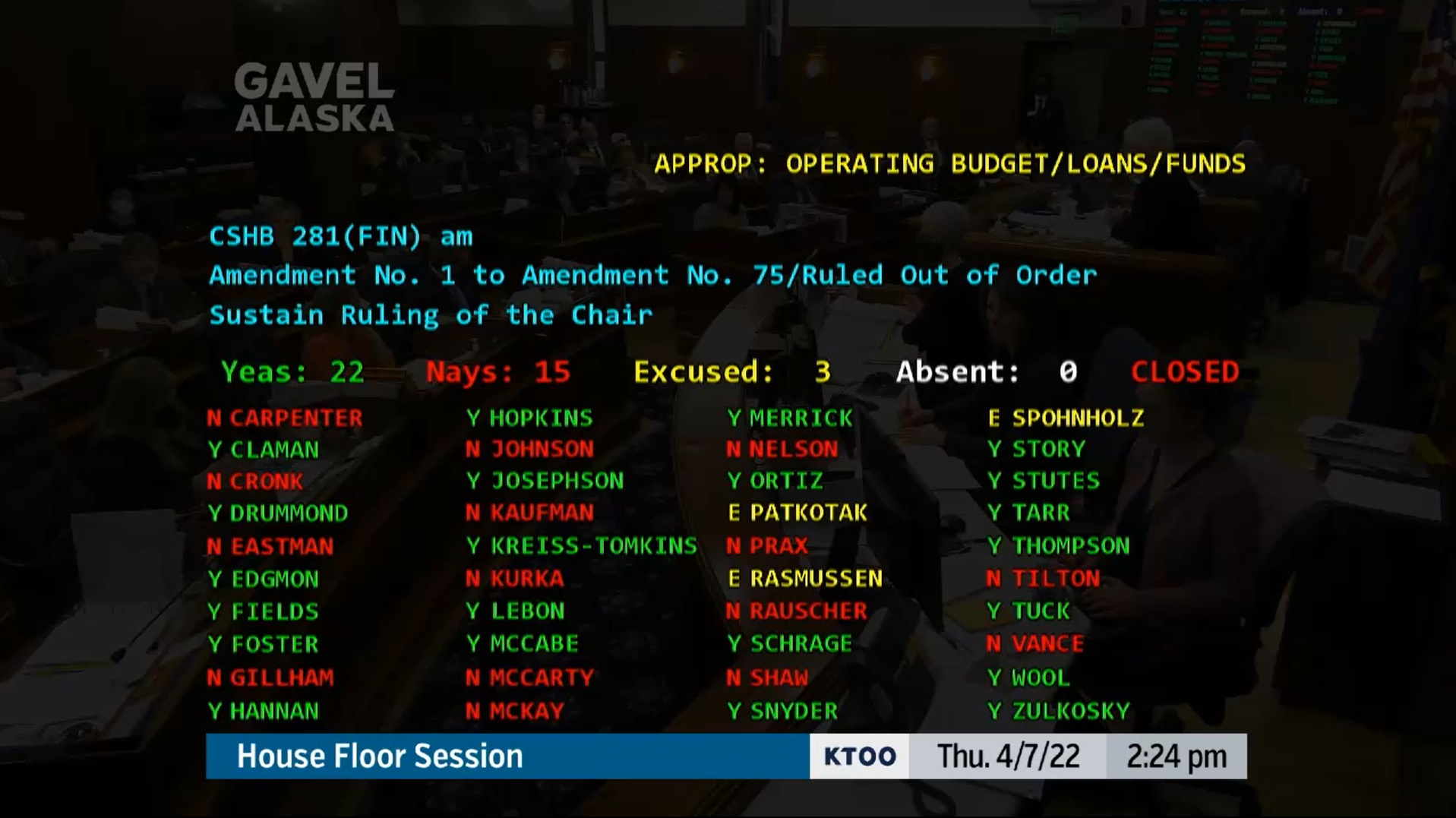
 (Rep. Kevin McCabe joins House Democrats in voting to prevent Alaska from ending its membership in ERIC, 4/7/22)
If you are like most Alaskans, it is terribly perplexing when your conservative, Republican legislator comes out in support of a piece of legislation like SB64 that the Democratic Party has chosen as a top priority. The reason legislators give in public for supporting a particular Democrat bill is because it will help Alaskans.
That explanation works, but only until you actually read what’s in it.
At that point you know something is wrong, but it doesn’t explain how your conservative legislator went down to Juneau and wound up carrying water for the Democratic Party.
As a Mat-Su legislator, time and time again, I watched Republican legislators, sometimes from very conservative parts of the state, become personally invested in helping Democrats pass laws that hurt the Republican Party and (more importantly) hurt their own constituents.
We saw it happen with SB91, the bill that applied critical race theory to our state criminal justice system. Before the vote was taken, the public loudly said “No thank you”. Even so, 21 Republicans joined Democrats in voting for it anyway, only to repeal it three years later after crime had exploded statewide. It made no sense. Three out of nine Mat-Su legislators joined Democrats in voting “yes.” It had nothing to do with helping Alaskans, and everything to do with lining up on the side of those in power in Juneau. The impact on every day Alaskans was catastrophic.
Only after watching this same process play itself out a second and then a third time did I eventually come to realize just how profoundly I had underestimated Juneau’s ability to turn outsiders into political insiders. The message to legislators in Juneau is clear. To be an insider, you need to learn to trust the process and then be willing to vote against your party and your constituents at times. Let that sink in. In the movie Shawshank Redemption, Red (Morgan Freeman) refers to this process as ‘being institutionalized.’ In the case of Juneau, it involves becoming dependent on the very things you were elected to change.
If you still can’t imagine how your very own conservative legislator could ever turn against you and vote for a bill like SB64, I appreciate your skepticism. I truly do. I was once in your shoes.
Why single out Senate Bill 64?
First, because it is at this very moment on the governor’s desk awaiting his signature. If he vetoes it, which I hope he does, it will shortly come up for a final vote in the legislature. Second, unlike some bills, it is terribly easy to demonstrate that SB64 is a partisan Democrat bill and a top priority for the Democratic Party.
The version of SB64 that is now sitting on the Governor’s desk was put together by Bill Wielechowski, a senate Democrat for the last 20 years. Every Democrat legislator in Alaska voted for it. Not 90% of Democrats. Not 99%. It passed with the votes of every Democrat legislator in Alaska. The Alaska Democratic Party celebrated publicly and even used the passage of SB64 as a fundraising pitch for the Democratic Party.
The Democratic Party doesn’t raise money supporting Republican bills. It doesn’t celebrate when Republican bills become law. It supports bills that are expected to result in more votes being counted for Democrats than Republicans on Election Day.
Republican legislators Rep. Sarah Vance (R-Homer) and Rep. Kevin McCabe (R-Big Lake) have publicly declared support for SB64 and are now framing it as an election integrity bill. They even go so far as to say that opposing SB64 “is a rejection of one of the central pieces of the current election integrity agenda of the President.”
You aren’t meant to think deeply when they say that.
If you happen to have been in a coma for the last 10 years, election integrity is not a current Democrat priority, just like legal immigration is not a Democrat priority. There is a strong positive correlation between illegal immigration and Democrat candidates winning elections. The more illegal immigration, the more Democrats in office. Photo ID will also never be a Democrat priority because there is a negative correlation between requiring photo ID and Democrat candidates winning elections. This is why you can get in trouble today if you ask someone to show their ID when you go to give them a ballot in places like California.
In contrast, election integrity has been a top priority for the White House. As part of that effort, the United States Department of Justice has requested voter roll data from every state, including Alaska. As it happens, Alaska maintains the dirtiest voter roll of all fifty states, running as high as 113% of our voting age population. By the way, unless you are connected to the Democratic Party, that is not something to be proud of. It means that our state voter roll includes thousands of people who cannot legally vote (e.g. deceased, felons, non-citizens, voters in other states, etc.).
By comparing voter data with federal agencies, North Carolina this week discovered 34,000 dead people on their state voter roll. That’s a win for election integrity. Unfortunately, the Alaska Democratic Party does not agree. That’s why the Alaska Black Caucus and the ACLU are currently suing the Dunleavy Administration to try to prevent the state from sharing Alaska voter roll data with the federal government.
Likewise, instead of supporting the efforts of the White House on election integrity, Rep. Vance is currently carrying water for Democrats. Last week, she even went so far as to argue that those concerned over the Division of Elections sharing our voter roll with the DOJ should help pass SB64 because it will limit how the state can share voter roll data in the future: “Your vote is private. Your information should be too.” Like the Democrats, Vance now refers to this as “voter privacy” and “data protection”. It sounds nice, until you realize that they are trying to “protect” our voter roll from the very people whose job it is to help us clean it up.
Transparency? No.
Election integrity? Not even close.
When we sought to include Photo ID in various election integrity bills going through the legislature, Rep. Vance opposed our efforts, voted against them, and encouraged other legislators to vote against them as well. She believed that Democrats wouldn’t support it. When we sought to include citizenship verification, she opposed it and publicly voted against it for the same reason.
When we sought to follow the example of other Republican states by ending Alaska’s membership in ERIC, Rep. Vance and Rep. McCabe not only voted against ending membership in ERIC, but they also voted to prevent other legislators from being able to debate it. Rep. McCabe even went so far as to join Democrats in voting to block ERIC membership from even coming up for a vote. Ten years on, most Republican states have left ERIC, but our voter roll continues to still be tied to it, which has only made the problem worse.
[See: “Voter Management System Used in Alaska Tied to Leftist Activists and Democrat Operatives” and “Texas Becomes Ninth State to Withdraw from ERIC Voter Roll Organization“]
As a state, we are willing to continue paying money to left-wing organizations like ERIC, and have been willing to share our voter roll data with them for the last ten years, but some Republican legislators have lately joined Democrats in arguing that we shouldn’t share our voter roll data with the Department of Justice. Make it make sense.
As a Republican legislator, when you find yourself publicly opposing Republican policies because Democrats in Juneau don’t support them, you have lost your way. When you begin to limit yourself and others to passionately advocate only for policies that will receive Democrat support, you have become, as Red would put it, “institutionalized.”
Put another way, your salt has lost its saltiness when it comes to election integrity. When that happens, it is then good for nothing but to be thrown out.